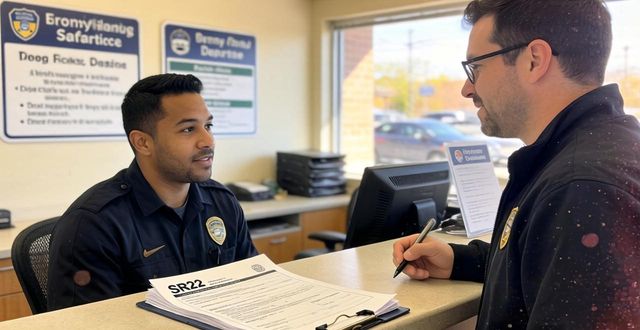
You don’t think about it. Not until the letter comes.
I was 23, driving a beat-up Honda Civic with a busted taillight and absolutely zero insurance. Got pulled over in Texas three years ago. Thought I’d just get a ticket and move on. Wrong.
The officer handed me that paper – “SR-22 required” – and my heart literally dropped.
I had no idea what it even was. Does it cost a million dollars? Does it follow me forever? What happens when I move to a different state next year? All those questions just spinning in my head at 2 AM.
So here’s what I learned. The hard way. The expensive way. But you don’t have to make the same mistakes.
What even is SR-22?
It’s not insurance. I know everyone calls it “SR-22 insurance” including me half the time, but technically it’s just a certificate your insurer files with the DMV. Proves you have the minimum liability coverage your state requires. That’s it [10†L3-L7].
Think of it like this – you still buy regular car insurance. The SR-22 is just an extra paper attached to it that says “hey DMV, this guy actually has coverage now” [12†L13-L16].
Why do you need it? Usually after serious stuff – DUI, driving without insurance, multiple tickets, reckless driving [12†L20-L21]. The state wants to watch you for a few years, make sure you don’t mess up again.
I got mine for driving uninsured. Felt like such a stupid mistake at the time. And honestly? Still feels stupid.
how long do I need SR-22 insurance?
I asked my insurance agent this same question five times. She probably thought I was slow.
Most states require 2 to 5 years. Usually around three years. It depends on your state and what you did [12†L31-L33].
Here’s the part that almost killed me – if your insurance lapses even for ONE DAY while you have SR-22, the clock resets. You start all over from year zero [12†L33-L34].
I nearly had a heart attack when I almost missed a payment last year.
My cousin in California got a DUI and needs SR-22 for five years. Meanwhile my friend in Arizona only needed two years for the same thing. It really just depends where you live.
is SR-22 coverage valid across state lines?
This was my biggest fear. I was planning to move from Texas to Colorado.
So I called my insurance company like three times, got different answers each time. Finally someone explained it clearly.
Your SR-22 is tied to the state that required it. Not where you live now. Not where you’re moving. The original state [11†L2-L3].
If you move to a different state, you still have to maintain the SR-22 filing with your original state until the requirement ends [3†L6-L8].
But here’s the tricky part – you ALSO might need to refile in your new state. Some states require it. Some don’t. You have to check [3†L19-L21].
I ended up having to maintain insurance that satisfied both states’ minimums. More expensive. Annoying. But necessary.
If you move to a state that doesn’t even use SR-22 (like New York or Pennsylvania), does the requirement just disappear? No. Your original state still expects you to keep it. You do what’s called an “out-of-state filing” [3†L28-L33].
Which states do not require SR-22?
Not every state uses SR-22 at all. About 39 states plus DC require it. The rest? Different systems [4†L12-L13].
States like New York, Pennsylvania, North Carolina, Kentucky, Minnesota don’t use SR-22 [4†L27-L28].
But don’t get excited. If you got your violation in a state that DOES require SR-22, moving to one of these “free” states doesn’t cancel your obligation. You’re still stuck with the filing requirement from the original state [20†L9-L14].
I learned this from a guy at work. Got a DUI in Ohio, moved to New York thinking he was free. Nope. His license got suspended again because he stopped filing.
how much does SR-22 insurance cost?
This is where people get freaked out.
The SR-22 filing fee itself is small. Like $15 to $50 bucks, one-time administrative fee [1†L40-L41].
The expensive part is your insurance premium because now you’re labeled “high-risk.”
National average after a DUI? Around $3,200 per year [13†L13-L15].
Before my violation, I paid about $1,200 a year. After the SR-22? Jumped to nearly $2,500. That hurt. A lot.
For non-owner policies (if you don’t own a car but still need SR-22), it’s cheaper – about 3 to 5 percent more than regular non-owner insurance [1†L36-L38].
Ways I saved money:
– Shopped around. Different insurers quoted me wildly different prices. One wanted $300 a month, another offered $150.
– Bundled my renters insurance with the same company. Saved maybe 10%.
– Took a defensive driving course online for $25. Dropped my rate a bit.

Not huge savings, but every dollar counts when you’re already paying double.
myths that almost tricked me
So many people gave me bad advice.
Myth: “SR-22 means full coverage.” No. SR-22 only proves you have minimum liability insurance. Not collision, not comprehensive. If you crash your own car, SR-22 won’t help you [25†L13-L18].
Myth: “Only DUI offenders need SR-22.” I never had a DUI. Still needed it. Driving without insurance, multiple tickets, reckless driving – all can trigger the requirement [25†L26-L31].
Myth: “You’re stuck with SR-22 forever.” It ends. Eventually. Three years felt like forever when I started. But now? I’m almost done. You’ll get there too [27†L39-L43].
Myth: “It costs thousands every month.” My premium went up, yes. But not to $2,000 a month. That’s just fear-mongering. The filing fee is cheap. The premium increase depends on your situation [25†L40-L44].
what happens if my SR-22 insurance lapses?
Do not let this happen.
Seriously.
If your policy cancels or you miss a payment,your insurance company has to notify the DMV immediately. Within days, your license gets suspended again [9†L22-L24].
And then your SR-22 clock resets. You’re back to three years. Or five years. Whatever it was, you start over [9†L24-L25].
I paid for automatic payments just to avoid this. Worth the peace of mind.
non-owner SR-22 insurance – what even is that?
If you don’t own a car but still need SR-22, you can buy a non-owner policy.
It provides liability coverage only – when you borrow a friend’s car, rent a car, or drive a company vehicle [17†L23-L25].
But important: if you live with someone who owns a car and you regularly drive it, you probably don’t qualify for non-owner. You need to be added to their policy instead [17†L31-L33].
I almost bought a non-owner policy by accident. My roommate had a car and I drove it every week to work. Would’ve been invalid coverage if I’d crashed.
real talk: how I survived my SR-22 period
It sucked. I won’t lie.
But I made it. Three years, almost done now.
What helped:
– Set calendar reminders for every payment. Never missed one.
– Called my insurer every six months to ask about rate drops. Annoying? Yes. Saved me like $20 a month eventually.
– Drove like a grandma. No speeding, no close calls, nothing. One more ticket and my SR-22 period would’ve extended.
– Talked to an independent agent who helped me compare quotes across multiple companies. Game changer.
You feel like a criminal at first. Like everyone’s watching you. But most drivers don’t even know what SR-22 is. Only you and the DMV know.
how to get SR-22 insurance fast
Step one: Find out exactly what your state requires. Check your court order or DMV notice [22†L16-L21].
Step two: Call insurance companies and ask point blank – “Do you handle SR-22 filings in my state?” Not all insurers do. Don’t waste time with ones that don’t [22†L35-L38].
Step three: Buy the policy. Tell them you need the SR-22 filed. Pay the filing fee.
Step four: The insurer files the form electronically with your DMV. You don’t do it yourself – they handle it [28†L49-L50].
Step five: Wait for confirmation. Usually takes a few days. Then you’re legal again.
I got mine filed in three days. Fastest was same-day with some companies.
final thoughts before you go
You’re probably stressed right now. I get it.
But SR-22 isn’t the end of the world. It’s just a piece of paper – an annoying, expensive, embarrassing piece of paper – that proves you have insurance.
Keep your policy active. Don’t miss payments. Drive carefully. And the time will pass.
Three years sounded impossible when I started. Now I’m counting down the last few months.
You got this. Really.
About the Author