You know what’s worse than getting a DUI?
The moment your stupid car hits a mailbox.
Or worse. A curb. A tree branch that falls out of nowhere.
Your front bumper cracks.
It’s fiberglass. You see this gnarly spiderweb of cracks spreading under the paint.
And you think — okay. I have SR-22 insurance now. I’m good. Right?
Wrong.
So wrong it hurts.
I learned this the hard way four months ago. And my wallet is still crying.
Here’s the thing nobody tells you when they hand you that stack of papers after a DUI.
SR-22 doesn’t pay to fix your own car.
At all.
Wait, so what does SR-22 even cover?
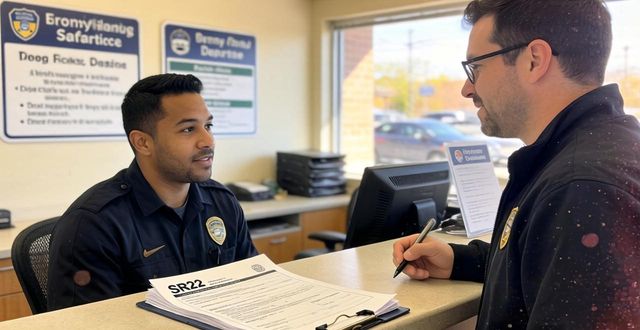
SR-22 isn’t really “insurance.”
I know. Everyone calls it that. The cops call it that. Your lawyer calls it that.
But it’s just a piece of paper.
A certificate. It proves to the state that you’ve bought liability insurance.
Liability pays for other people’s cars if you cause an accident. Not your fiberglass. Not your bumper.
Just their repairs.
“It’s basically your insurance company telling the DMV, ‘Hey, this driver has the minimum coverage required by law’” [10†L2-L4].
That’s it.
The fiberglass gut-punch
My damage was a cracked front fender.
Right along the wheel well. About eight inches long.
The body shop guy looked at it. Whistled. “Thirty percent depreciation on fiberglass,” he said.
I stared at him like he was speaking Chinese.
It’s actually a thing. While glass parts get zero depreciation, fiberglass components get a 30% haircut on repair costs [12†L23-L32].
Insurance pays for the part, sure. But they deduct 30% automatically because your bumper is technically “older” than the rest of the car.
I didn’t know this.
Now I owe $437 out of pocket on top of my deductible. For a mailbox swipe.
The “full coverage” lie
When I got my policy reinstated, I asked for “full coverage.”
The agent nodded. I signed.
Turns out that doesn’t mean what you think it means.
“Full coverage” is not an actual policy type. It’s just a sloppy way of saying liability + comprehensive + collision [15†L3-L16].
And here’s the gut punch — even if you do have comprehensive and collision (the ones that would cover your fiberglass), you still have deductibles. Usually $500 to $1,000.
So if your repair estimate is $800…
You pay $500.
Insurance pays $210 (after depreciation shenanigans).
You sit there feeling like an idiot.
How the pros handle fiberglass damage
I talked to a bodyshop guy who’s been doing this for twenty years.
He says the insurance adjusters treat fiberglass like it’s made of gold dust.

“They look for any reason to deny or reduce”
“Old cracks? Not covered. Poor maintenance? Denied.”
But here’s his advice:
Take photos immediately. Daylight photos. Close-ups.
Get two or three repair estimates (body shops know how to word things for insurance).
If it’s comprehensive (tree fell, vandalism, hail), you’re in better shape. If it’s collision (you hit something), prepare for lower payout [14†L3-L10].
I kept every receipt. Every photo. Even the gas station receipt from that morning.
The truth about SR-22 and damage claims
Honestly? You’re probably not getting much.
Here’s the math that made me want to throw my phone:
Your fiberglass repair = $1,200.
$500 deductible
$360 depreciation (30% of parts cost)
You pay $860
Insurance pays $340
On a “good” day. With full coverage.
If you only had liability + SR-22? You get zero.
Because liability doesn’t touch damage to your own car. Ever [9†L31-L34].
Why I almost dropped collision coverage
After my mailbox incident, I was livid.
I called my insurance company ready to cancel collision coverage altogether.
“Why am I paying for something that barely covers anything?!”
The agent was calm. Too calm.
“You still have a loan on this vehicle,sir.”
Right.
If you finance or lease, you can’t drop collision. The lender requires it so their asset stays protected [15†L38-L44].
So I’m stuck. Paying $278 per month for the privilege of still shelling out $860 every time I mess up.
What I wish I knew six months ago
First. SR-22 is not a magic shield. It’s just a certificate. It proves you have liability insurance, nothing more.
Second. You need comprehensive and collision for your own repairs. And even then, check your deductibles. A $1,000 deductible on $800 damage means you get nothing from insurance.
Third. Read your policy like a paranoid person. The agent won’t explain depreciation on fiberglass unless you ask.
Fourth. If your car is older and paid off, consider dropping collision coverage after your SR-22 requirement ends. The annual premium might be more than the car is worth [15†L48-L52].
Fifth. Save up a separate “stupid mistake” fund. Because no matter what insurance says, you’ll be paying something.
The last thought
You probably got an SR-22 because of a DUI. Or no insurance. Or a lapse.
I get it. I was there too.
It sucks. The fines suck. The premiums suck. And finding out your cracked fiberglass bumper is basically on you? That’s the cherry on top.
But here’s the tiny silver lining:
Once you serve your SR-22 term (usually 1-3 years depending on your state) [16†L15-L16], you can shop around again. Compare quotes. Possibly drop some coverages.
Until then…
Drive carefully. Park far away from poles. And maybe hug your bumper every morning before you start the engine.
Because the only thing SR-22 guarantees is that you’re legally on the road.
Not that your paint job survives.
About the Author