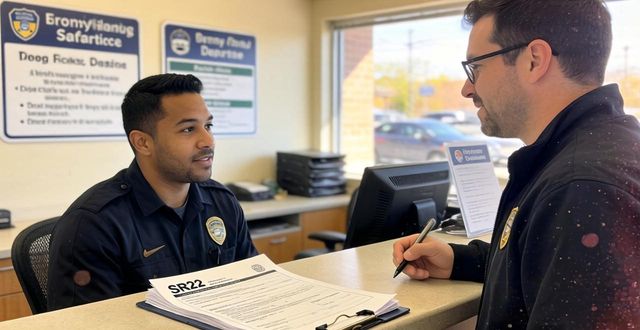
Look, I’ve been there. Your license just got suspended, the court says you need an SR-22,and your van is your whole damn business.
You fix other people’s cars for a living. But right now, you can’t even legally drive your own.
I know. It’s messed up.
What is SR22 insurance anyway
Here’s the thing nobody tells you. SR-22 isn’t actually insurance. It’s a form your insurance company files with the DMV to prove you carry the minimum liability coverage your state requires. Think of it as the state watching you.
You get labeled a high-risk driver. Usually happens after a DUI, reckless driving, driving without insurance, too many tickets, or an accident while uninsured.
And if your policy lapses even for one day? Your insurer files an SR-26 form and the DMV suspends your license again. Immediately.
No pressure, right?
mobile mechanic SR22 problem
Let me guess. You drive a work van packed with thousands of dollars in tools. You drive customers’ cars for diagnostics and test drives. You might even tow vehicles.
Here’s the ugly truth. Most standard SR-22 policies are designed for regular folks commuting to a 9-to-5. Not for someone who drives for work. Not for someone who makes money behind the wheel.
If you get pulled over in your work van without proper coverage? That’s not just a ticket. That’s your business shutting down.
can mechanic file sr22
Real quick—I need to clear something up. No, your mechanic cannot file your SR-22 for you. Only your insurance company can file it directly with the DMV.
I’ve seen people ask their mechanic to “handle the paperwork.” That’s not how it works. Call your insurer. They handle the filing.
non owner sr22 for mobile mechanics
Wait. What if you don’t own the van you’re driving for work?
Maybe you’re leasing it. Maybe it’s your spouse’s vehicle. Maybe you’re an employee driving a company truck.
This is where non-owner SR-22 comes in.
Non-owner SR-22 is for drivers who don’t own a vehicle but still need to prove financial responsibility to get their license back.
Here’s the catch though. Non-owner policies are liability-only. They won’t cover damage to the vehicle you’re driving. And they definitely won’t cover your tools or equipment.
So if you crash your work van while delivering a transmission to a customer? The non-owner policy covers the other guy’s car. Your van? Your problem.
sr22 insurance cost for mechanics
Let’s talk money. Because this stuff isn’t cheap.
Average SR-22 filing fees run $15 to $50, one time. But the real cost is the premium spike.
After a DUI, drivers pay around $275 per month. That’s way higher than standard rates. For driving without insurance, you’re looking at about $665 per year.
Now add mobile mechanic business insurance to that. General liability. Commercial auto. Tools and equipment coverage. Professional indemnity.
You’re easily looking at $150 to $300 monthly just for commercial auto, on top of your SR-22 marked-up personal policy.
I’m not gonna sugarcoat it. This hurts.
sr22 filing process step by step
Okay, let’s actually do this. Here’s the process.

Step one. Confirm you actually need an SR-22. Check your court order or DMV notice. Usually required for 3 years, sometimes 5. In California, DUI convictions can require 3 to 10 years.
Step two. Find an insurer that handles SR-22. Not all of them do. Call around.
Step three. Buy a policy that meets your state’s minimum liability coverage.
Step four. Ask them to file the SR-22 with your DMV. They’ll charge you that $15 to $50 filing fee.
Step five. Pay your driver’s license reinstatement fee. That’s often another $100 or so.
Step six. Don’t let your policy lapse. Seriously.
but I need to drive customer cars
Here’s where it gets tricky.
If you need to test drive a customer’s car after making repairs, your personal SR-22 policy usually won’t cover that. That customer’s vehicle is not on your insurance.
You need commercial coverage specifically for driving customers’ vehicles. Motor trade insurance. Road risk coverage. Something that explicitly covers non-owned vehicles you operate for business.
Ask your agent. Be specific. Say “I drive other people’s cars for diagnostic purposes.” If they don’t understand that, find a different agent.
garagekeepers coverage and SR22
One more thing.
What if a customer’s car gets damaged while it’s sitting in your driveway, waiting for parts? Your SR-22 doesn’t cover that.
You need garagekeepers liability. It covers customers’ vehicles in your care, custody, or control. Even if you don’t have a physical shop.
Mobile mechanics skip this all the time. Then a hail storm hits. Or their dog jumps on a hood. Or a tree branch falls on a BMW.
Don’t be that mechanic.
real talk about getting through this
I’m not gonna lie. Having an SR-22 requirement and running a mobile mechanic business at the same time is hard. It’s expensive. It’s stressful.
But here’s what I learned.
Shop around. Rates vary like crazy between insurers for high-risk drivers. Some might quote you $150 a month, another might say $250 for the exact same coverage.
Bundle if you can. Combine your SR-22 policy with renters or homeowners insurance. Might save you something.
Pay upfront if possible. Monthly payments usually come with extra fees.
And remember. This requirement doesn’t last forever. Most states only require SR-22 for 3 years, assuming you stay clean.
The bottom line
Your SR-22 won’t fix your van. It won’t cover your tools. It won’t protect you when you crash a customer’s car.
You need both. Personal SR-22 coverage to get your license back. And proper mobile mechanic business insurance to actually do your job.
Call an agent who specializes in high-risk drivers and mobile businesses. Tell them exactly what you do. Let them build a package that covers both sides.
Because your livelihood depends on driving. Don’t let paperwork or the wrong coverage end your career over one mistake.
You’ve fixed hundreds of cars for other people. Now fix this for yourself.
About the Author