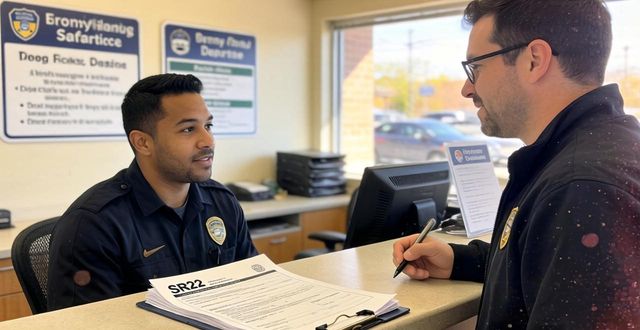
I got this letter from the DMV last Tuesday.
My heart sank.
“SR-22 required.”
I stared at those words.
What the hell is SR-22 insurance? I’ve had car insurance for years. Why do I suddenly need something else?
Yeah, I’d let my policy lapse. Three months. A stupid mistake.
But now my license is suspended. And this form — this stupid form — is the only way to get it back.
What IS SR-22 anyway?
Here’s the thing nobody tells you.
SR-22 isn’t insurance.
I know. The name is confusing as hell. Everyone calls it “SR-22 insurance” — insurance companies,websites, even the DMV sometimes — but it’s not a separate policy.
It’s literally just a form.
A certificate of financial responsibility, they call it.
Your insurance company files it with the state. That’s it. The form tells the DMV: “Hey, this person now has the minimum required liability coverage. We’re watching them.”
That’s the part that got me. The state doesn’t trust me anymore. So they’re making my insurance company tattle on me if I mess up again.
If your policy lapses or gets canceled while the SR-22 is active? Your insurer has to notify the DMV immediately.
And boom. License suspended again.
No second chances.
Who the hell needs this thing?
The short answer: high-risk drivers.
The DMV basically puts a flag on your record after certain violations — DUI, driving without insurance, reckless driving, too many tickets in too short a time, sometimes even unpaid child support (I didn’t know that either until I started researching).
In my case? Driving uninsured.
I thought I’d save a few hundred bucks by letting my policy expire during a tight month. The policy lapsed. Three months later I got a notice from the DMV. My license was suspended.
The reinstatement requirement was simple: Get an SR-22 filing, keep it active for three years, and don’t let your coverage drop again.
Three years.
That’s a long time to be watched.
How much is this going to cost me?
Okay, here’s the part that made me almost give up.
The SR-22 filing fee itself? It’s not bad. Usually $15 to $50 as a one-time charge.
That’s not the problem.
The problem is what happens to your insurance premiums.
Once you need an SR-22, you’re officially labeled a “high-risk driver.” And insurance companies take that very seriously.
On average, drivers who need an SR-22 pay $1,500 to $3,000 MORE per year than drivers with clean records.
For a DUI? It can be even worse. Average annual costs can hit $3,295, with monthly payments around $275.
I got quotes ranging from $180/month to $450/month for the exact same coverage.
Same driver. Same car. Same state.
The difference? Which company’s algorithm you end up with.
So here’s my advice — shop around. Get at least 3 to 5 quotes. The gap between the cheapest and most expensive can easily be $1,000+ per year.
Do I need an SR-22 if I don’t own a car?
This was a huge question for me when I was freaking out.
I actually don’t own a car right now. But I still need my license for work. For borrowing my roommate’s car. For emergencies.
Turns out, you can absolutely get a non-owner SR-22 policy.

It’s liability-only insurance that follows you, not a specific vehicle. You’re covered when you drive borrowed or rented cars.
And the good news? Non-owner policies are usually cheaper than standard owner policies because they don’t cover vehicle damage — just liability.
The bad news? You still have to keep it active for the full filing period. No skipping months just because you’re not driving that week. Lapse means suspension.
How long do I actually need to keep this thing?
Most states require SR-22 filings for three years from the date you reinstate your license.
Some states are shorter — Oregon just changed its rule to one year for driving uninsured. Some are longer. Repeat DUIs can push it to five years or more.
Here’s the killer detail.
If your policy lapses at any point during that period? The clock resets.
I called my insurance agent to confirm this because it sounded insane.
She said yes. If you drop coverage in month 35 of a 36-month requirement, you don’t just have to refile. You start all over. Three more years.
Do not let your policy lapse.
Set up autopay. Mark your calendar. Do whatever you have to do.
How do I actually get an SR-22?
The steps are surprisingly straightforward.
First, call your current insurance company and ask if they handle SR-22 filings. Not all of them do. Some companies refuse to insure high-risk drivers at all.
If your current insurer doesn’t offer SR-22, you’ll need to switch to one that does.
Some of the more affordable options for high-risk drivers: The General specializes in non-standard insurance and is often the cheapest for DUIs or suspended licenses. Progressive is relatively accommodating and has a Snapshot program that can lower your rates based on driving behavior. Direct Auto has a strong presence in southern states with physical locations. GEICO will file SR-22 for existing customers.
Once you’ve chosen an insurer, they’ll add the SR-22 endorsement to your policy and file it electronically with your state’s DMV.
You pay the filing fee — usually $15 to $50.
Then you wait.
In most cases, the filing is confirmed within 24 hours. Once the DMV has it on record, you can reinstate your license.
Then the real work begins. Three years staying compliant.
What happens if I move to another state?
This almost tripped me up.
I was planning to move to Texas next year for a job. But I needed my SR-22 now. What happens if you move mid-filing?
The answer: your SR-22 requirement follows you.
You need to notify your insurance company of your new address. They can usually refile the SR-22 in your new state, but the coverage requirements might be different. Minimum liability limits in Texas are higher than in some other states, for example.
The three-year clock doesn’t reset just because you move. But you do need to make sure your insurance is valid in your new state of residence. Don’t assume it’s automatic.
Here’s what I wish someone had told me on day one
I spent two weeks panicking. Avoiding the DMV letter. Pretending it would go away.
It didn’t.
Here’s what I learned:
The SR-22 itself isn’t the enemy. The filing fee is small. The real cost is the insurance premium increase. But that increase doesn’t have to be permanent.
Every month you drive without new violations, your risk profile improves. You can ask your insurer to re-evaluate your rates after a year or two of clean driving.
Also — don’t just accept the first quote you get. Different insurers use different algorithms. One company might weigh your specific violation heavily. Another might care more about your credit score or your age. The quotes will vary wildly. Use that.
And for the love of god, set up autopay. The consequences of a lapse are brutal. Your license gets suspended again. The clock resets. You might even face additional fees and penalties from the DMV on top of everything else.
One missed payment can cost you years.
I’m six months into my SR-22 period now. Premiums are still higher than they used to be. But I’ve learned to budget for it. I check my insurance app every month to make sure everything’s active. I’m paranoid about it, honestly. But that paranoia keeps me compliant.
The form isn’t punishment. It’s monitoring.
And eventually, after three years, it goes away.
You just have to earn your way out.
About the Author